Senior Secured Loans (SSL) are:
- debt instruments collateralised by assets pledged by the borrower
- provide much higher return than similar rated / risk adjusted bonds
Benefits of investing in SSL through Collateral Loan Obligations (CLO) securities:
- mostly rated securities constantly reviewed by official rating agencies
- over-collateralisation of the CLO notes
- selection and active management of the loan portfolios by top tier asset managers
- tradable securities
- detailed transparency on all the characteristics of the loan portfolio (CLO)
Investment in Senior Secured Loans through CLO notes historically outperformed the traditional bond market and proved to be safer compared to similar rated investments.
Main features of broadly syndicated Senior Secured Loans:
- provided by major banks to medium-large rated corporations
- issued with maturity typically of 5 to 6 years
- flexible funding instrument repayable earlier without penalty
- indexed usually to 1, 3 or 6 months SOFR/Euribor.
- senior secured obligations: collateralised by assets pledged by the borrower
- typical size varies between $1 to $5 billion
- tradable instrument as lender banks provide daily prices
The Avenida Funds provide access to a diversified portfolios of loans (CLO notes) selected and actively managed by asset managers such as Apollo, ARES, Blackstone, Carlyle, CVC, KKR, Neuberger, PGIM, UBS AM, etc.
Avenida Team’s experience:
- specialised on this asset class for well over 20 years
- track record backdates since the early 2000
- average return of its 92 selected loan portfolios subordinated investments +13%.
The Avenida Funds:
- offer access to different portfolios of Senior Secured Loans
- each fund is highly diversified in over 1200 different loans where the combined top 10 exposures are limited to 6-7%
- strict due diligence and selection process of the best CLO (portfolio of loans) instruments so to achieve absolute returns on a risk-adjusted basis
- each CLO portfolio comprise on average over 250 different loans selected by the top asset managers.
The actively managed feature, the over-collateralization structure typical of CLOs and the monthly oversight of rating agencies have proved that this asset class has been historically 8-10 times more secure than similar rated corporate bonds.
Loans pay a spread over short-term base rates (Sofr/Euribor) which means that the interest received adjust regularly, making Loans/CLOs an ideal investment in a high-rate environment as it avoids the duration risk seen with most fixed income alternatives.
US and European CLOs do not invest in emerging market debt, they do not have forex exposure, they exclude real estate, credit card, consumer or student loans.
What is a CLO
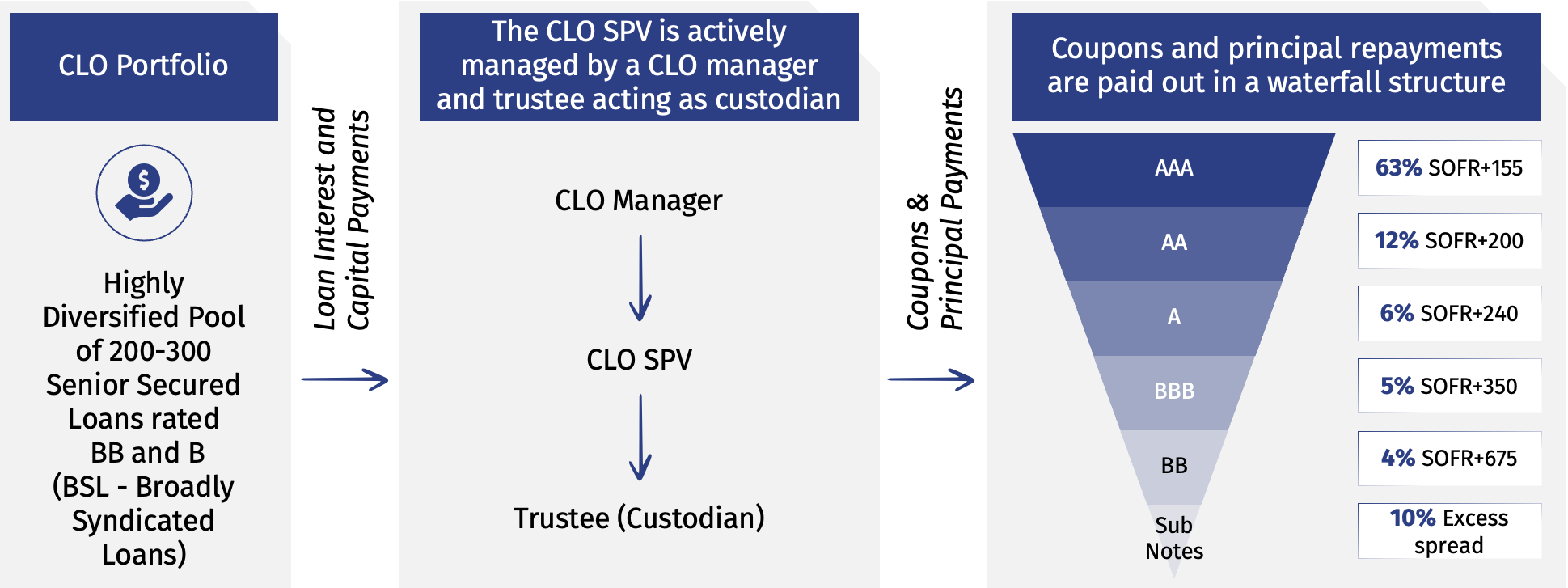
A Collateralized Loan Obligation (CLO) is a funding vehicle that buys mainly senior secured loans as assets and issues rated debt notes (from AAA to BB/B) and an unrated subordinated tranche.
CLOs have a highly diversified loan portfolio. It is common to have more than 300 unique loan issuers across 15-25 industries. The portfolio needs to maintain certain metrics, which include tests on portfolio diversity score, weighted average spreads (WAS) and weighted average rating factors (WARF), weighted average life (WAL), minimum overcollateralization, etc.
CLOs’ portfolios are actively managed and profit is created in the arbitrage between a CLO’s portfolio assets (interests on loans) and the cost of servicing its debt (coupons paid on the debt tranches).
Post-GFC, CLOs changed significantly with increased credit enhancement for subordinate tranches and more restrictive indentures. The new deals post-GFC are called CLO 2.0.
A typical CLO has a 5-year reinvestment period during which the asset manager reinvests proceeds from prepaid loans; after this time, loans’ reimbursements are used to repay the most senior debt tranches, starting the amortization period.
After the non-call period, typically 2 years, a CLO can refinance the debt notes: i.e., pay debt holders in full and reissue debt at a lower spread. Refinancing tranches enable the deal to reduce funding costs. If credit spreads tighten, the deal can take advantage of this and improve the excess spreads distributed to the subordinated note holders. A Refinancing can be for specific debt tranches, while a Reset involves all the debt tranches. A Reset allows to extend the reinvestment period and further improve the excess spread that flows to the investors in the subordinated tranche.
Waterfall payments is a type of payment scheme in which higher-tiered creditors initially receive interest and principal payments first, while the lower-tiered creditors receive principal payments only after the higher-tiered creditors are paid back in full.